


AI Photo Video Generator: IRMO
MOBIVERSITE YAZILIM BILISIM REKLAM VE DANISMANLIK
I spent time with AI Photo Video Generator: IRMO to see whether its main promise—turning creative ideas into AI-assisted visual content—is useful beyond a quick novelty. My overall impression is that it is most interesting when I treat it as a starting-point machine rather than a complete replacement for an editor. It can help me move from a rough concept to something shareable without opening a complicated desktop program, especially when I want to experiment with an image style, a character concept, or a short visual post.
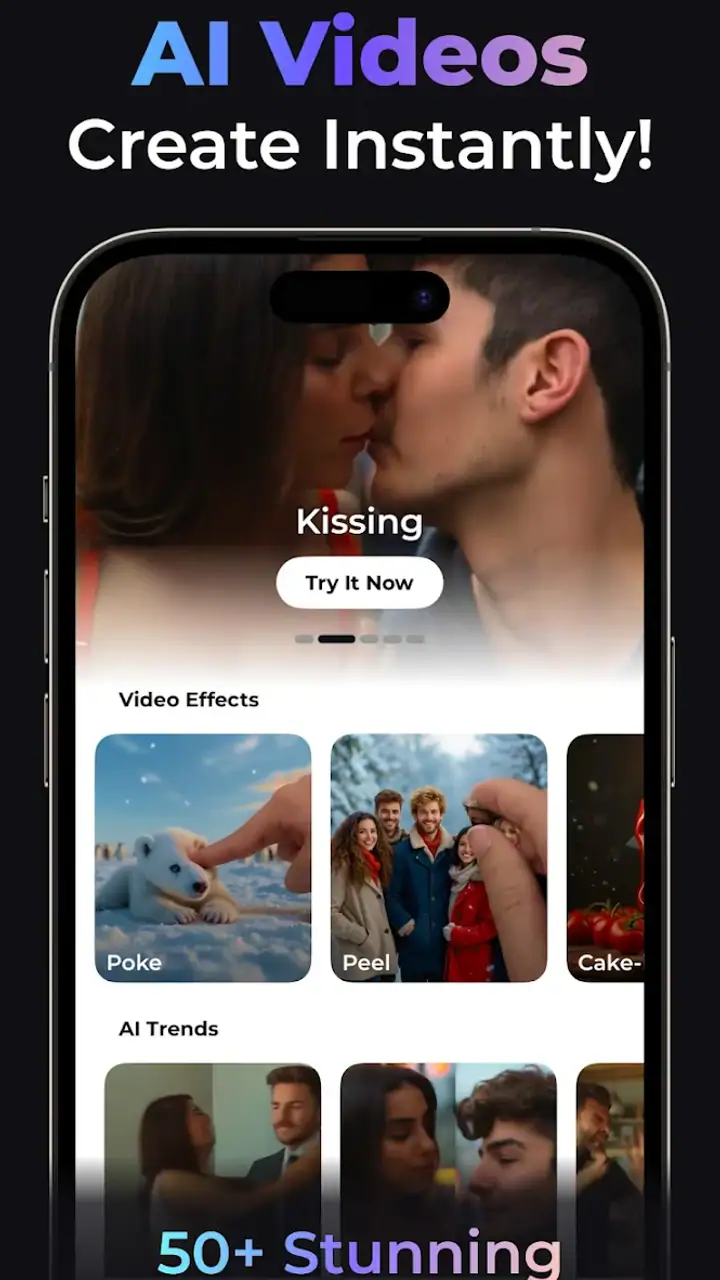
That focus makes sense for an app in the art and design category. IRMO brings together AI video generation, trend-oriented photo creation, character avatars, viral-style clips, and art filters in one mobile workspace. I would not approach it expecting the same control as a professional editing suite. Instead, I see it as a fast way to explore visual directions, test an idea, and create material that can later be refined elsewhere.
The app is free to install and is suitable for Everyone, which lowers the barrier for casual experimentation. It has built a sizable audience, with over 500 thousand installs and a 4.5 average from around 19 thousand ratings. Those figures suggest that the concept is appealing to many mobile users, although popularity alone does not guarantee that every generated result will match a specific creative brief.
Why the AI generation capability matters in everyday use
The strongest part of IRMO is not simply that it adds effects to a picture. The more useful idea is that it helps me reinterpret an ordinary photo or a loose visual prompt into something with a clearer mood. That difference matters when I have an idea but lack the time, drawing ability, or patience to build the result manually.
For example, I can imagine using it before posting about a small personal project. Rather than spending an evening assembling a visual identity from separate apps, I could use a photo as a starting point, try an artistic treatment, and then compare several directions. The value is in the speed of the first draft. Even when the result needs correction, I have something concrete to judge instead of an empty canvas.
Related News

Why WhatsApp Messenger Still Makes Everyday Communication Feel Easy

Jurassic World: The Game Is the Better Dino Tycoon for Strategic Players

Threads in Real Life: Who Should Join, Lurk, or Leave

How SHEIN Turned Shopping Into an Endless Content Feed

How to Make Fortnite Feel Smarter on Mobile

Should You Switch to Microsoft Outlook on Mobile?
The same approach works for character concepts. An avatar can help someone visualize a profile image, a fictional persona, or a playful version of themselves. I would keep expectations realistic: an AI-generated character is better viewed as an interpretation than a guaranteed likeness. Small details such as facial expression, clothing, or the relationship between a person and the background may not come out exactly as imagined.
IRMO also makes sense for short-form content creators who need a visual hook. A stylized image or animated treatment can make a familiar photo feel more suitable for a social post. The app’s emphasis on viral clips and trend photos points toward quick, attention-grabbing experiments rather than carefully controlled commercial production.
The practical advantage is speed from idea to draft, not perfect control over every pixel. That is the distinction I would keep in mind before installing it. If I need a polished brand asset with exact typography, consistent characters, or precise product placement, I would still choose a conventional editor or a dedicated design tool. If I need inspiration or a visually interesting first version, the AI approach is much more convenient.
Gallery
What the creative workflow feels like
My preferred way to use an app like this is to begin with a clear purpose instead of tapping through effects at random. I might decide that I need a dramatic profile image, a playful avatar, or a short visual for a story post. Starting with that goal makes it easier to judge whether an output is genuinely useful or merely eye-catching for a few seconds.
I would then test the same source image in more than one visual direction. This is one of the less obvious benefits of AI-assisted creation: comparison becomes part of the design process. A single photo can suggest a soft illustration, a bolder art treatment, or a more character-focused result. Looking at alternatives helps me discover which parts of the original image are worth preserving.
A useful habit is to keep the first generation simple. If I ask for too many changes at once, it becomes difficult to tell which instruction caused an unwanted result. I prefer to establish the main subject and mood first, then adjust the visual direction in a separate attempt. This makes the process less frustrating and gives me a clearer sense of what the app handles well.
Another practical tip is to choose source photos with one obvious subject and a reasonably clear composition. AI effects have less visual confusion to resolve when the person or object is easy to identify. Busy group photos, tiny subjects, and cluttered backgrounds can make the transformation feel less convincing. This is not a flaw unique to IRMO, but it becomes noticeable when the app is being used for fast results on a phone.
I also recommend saving the original image before experimenting. The creative process is more relaxed when I know I can return to the untouched photo. That matters because an attractive filter is not always the best choice for the original purpose. A dramatic result might work for a temporary social post but feel unsuitable for a professional profile or a family image.
The best everyday scenario for IRMO
The clearest use case for me is a person preparing several social posts around a small event, hobby, or personal project. Imagine taking photos at a weekend craft market and wanting a few different kinds of content afterward. One image could become an artistic post, another could receive a more energetic treatment, and a third could serve as the basis for a character-style visual. Instead of making every post look identical, the app can help create a small range of moods from the same day.
This workflow is especially helpful when the user is not a designer. A conventional editor may offer more control, but that control also creates decisions about layers, masks, curves, blending, and export settings. IRMO is easier to approach when the goal is to explore rather than manually construct every element.
I can also see value for someone planning a birthday message, travel recap, or personal announcement. A generated visual can provide a more memorable presentation than a plain photo, and the mobile format suits moments when the idea appears away from a computer. The app is at its best when the content is personal, informal, and open to interpretation.
For a small creator, the workflow can be even more useful if it is treated as a batch of concepts. I would generate a few different directions, choose the one with the strongest composition, and finish the wording or layout in another tool if necessary. That division of labor is important. IRMO can supply the visual spark, while a dedicated editor can handle exact text placement and final presentation.
There is also a less obvious benefit for people learning visual design. Seeing how the same source image changes under different styles can teach me to notice color balance, subject isolation, contrast, and mood. The app does not replace design knowledge, but it gives me quick examples to compare. That makes it useful as an idea generator, even when the final work is completed somewhere else.
Where the trade-offs become noticeable
The first trade-off is predictability. AI generation can produce an image that feels more creative than expected, but it can also move away from the original intention. If I need a person to remain instantly recognizable, or if a particular object must retain its exact shape, I would inspect the result closely before sharing it. A visually attractive transformation can still be wrong for the task.
Consistency is another concern. One generated image may look excellent while the next uses a different interpretation of the same subject. That is acceptable for individual posts, but it becomes inconvenient when I am trying to build a uniform series. A brand, online shop, or recurring character usually benefits from repeatable controls, and a traditional design workflow may be safer in that situation.
The free entry point is helpful, but the app includes in-app purchases ranging from $2.99 to $79.99 per item. I would therefore explore the free experience first and decide whether the creative results justify any optional spending. Users who generate frequently should pay attention to how quickly their interest turns into repeated purchases. The most sensible approach is to treat paid options as a deliberate choice, not as a requirement for every experiment.
There is also a difference between a fun result and a finished result. Some outputs may be ready to share immediately, while others may need cropping, text, color correction, or a second round of editing. I would not rely on IRMO alone for a campaign where every image must follow strict dimensions and visual rules. The app is more comfortable in the exploratory stage than in the final quality-control stage.
Speed can create its own problem: too many options. When every photo can become a filter experiment, it is easy to spend time collecting variations without deciding what to publish. I get better results when I set a limit, such as choosing only a few promising directions and rejecting the rest quickly. That keeps the app from becoming a distraction disguised as productivity.
Privacy and personal comfort should also guide the choice of source material. I would be cautious with sensitive documents, private family images, or photographs containing people who have not agreed to be used in an AI creation workflow. Even for casual use, it is worth thinking about whether a particular picture belongs in an experimental tool at all.
How it compares with familiar alternatives
Compared with a standard filter app, IRMO feels more idea-driven. A regular filter usually applies a predictable visual treatment, which is useful when I want consistency and speed. IRMO is more appealing when I want the image to become something different from the original. The trade-off is that the result may be less controlled and less uniform.
Compared with a full mobile editor, it is easier to approach but not as precise. Traditional editors are better for exact cropping, layered composition, typography, retouching, and repeatable templates. I would choose one of those when the final image must match a brand guide or a fixed publishing format. I would choose IRMO earlier in the process, when I am still deciding what the visual should feel like.
Compared with a desktop creative suite, the phone-first experience is naturally more convenient for spontaneous work. I can experiment during a commute, while traveling, or immediately after taking a photo. The compromise is that detailed review and fine correction are less comfortable on a small screen. For serious production, I would use the app as a concept generator and move the strongest result into a more controlled workflow.
That comparison also explains why I would not recommend replacing every other creative app with IRMO. Its value comes from a particular role: rapid AI-assisted transformation. It complements a photo editor, a design app, or a video finishing tool better than it competes with all of them at once.
Who will get the most from it
I think IRMO is a good fit for casual creators, social media users, people who enjoy avatar experiments, and beginners who want visual results without learning a complex interface first. It is also useful for anyone who regularly feels stuck at the blank-page stage. A few generated directions can make it easier to decide what to create next.
It may appeal to small creators who need variety but do not have a designer available for every post. The app can help turn ordinary source material into a more distinctive starting point, especially when the content does not need strict commercial consistency.
I would be more cautious about recommending it to professional photographers, brand managers, or anyone producing client work with exact requirements. Those users may appreciate the inspiration, but they will probably need another application for precision, repeatability, and final delivery. I would also suggest skipping it if the main goal is straightforward photo correction rather than imaginative transformation.
Device compatibility is relatively broad: the app supports Android 7.0 and later. The current version is 1.2.37, and the developer is MOBIVERSITE YAZILIM BILISIM REKLAM VE DANISMANLIK. Those details make it accessible to many Android users, although the experience of AI creation can still vary depending on the phone and the complexity of the task.
My final view after using its creative approach
IRMO works best when I give it a clear but flexible assignment. “Make this more interesting” is too vague even for an AI tool; a defined subject, mood, and intended audience produce a more useful creative session. I also get more value when I accept that the first output is a draft and compare it with alternatives instead of treating every result as final.
The app’s strongest contribution is lowering the effort needed to explore visual ideas. It can make a personal photo feel more expressive, help a beginner imagine an avatar, or provide a quick direction for a short-form post. Its limitations—variable results, less precise control, and optional purchases that can become expensive—mean that I would not use it as my only design tool.
For me, the recommendation is simple: install it if you want fast, playful AI-assisted art experiments and are comfortable refining the best results elsewhere. Skip it if you need exact layouts, dependable visual consistency, or traditional photo adjustments above all else. Used in the right role, AI Photo Video Generator: IRMO is a practical creative launchpad rather than a complete studio, and that is where its mobile convenience has the most real value.
FAQs for AI Photo Video Generator: IRMO
What is AI Photo Video Generator: IRMO?
AI Photo Video Generator: IRMO is a mobile creativity app designed to turn photos, text prompts, and visual ideas into AI-generated images or short videos. After testing its main tools, the app feels aimed at casual creators who want quick social-media content without advanced editing skills. Results depend heavily on the prompt, source image, selected style, and the app’s available AI models.
How do you create images or videos with IRMO?
To use IRMO, you generally choose a creation feature, upload a photo or enter a description, select an available visual style or effect, and start the generation process. The app then processes the request before displaying the result for saving or sharing. Clear prompts and high-quality source images usually produce better outcomes, while complicated instructions may require several attempts.
Is AI Photo Video Generator: IRMO free to download and use?
IRMO can typically be downloaded without an upfront charge, but users should expect possible limitations on free generations, credits, export options, or premium effects. Some features may require a subscription or in-app purchase. Before confirming payment, check the current pricing, renewal terms, trial conditions, and whether unused credits expire, since these details can change between app versions and regions.
Does IRMO protect uploaded photos and personal information?
Because IRMO uses cloud-based artificial intelligence, uploaded photos or prompts may need to be sent to remote servers for processing. Before using personal, private, or identifiable images, review the app’s privacy policy and permission requests carefully. Avoid uploading sensitive documents or photos of other people without consent, and check whether generated content and source files are retained or deleted.
What are the main limitations of AI Photo Video Generator: IRMO?
IRMO is convenient for experimenting with AI visuals, but it is not a replacement for professional photo or video software. Generation times can vary, results may contain visual errors, and faces, hands, text, or complex backgrounds may not always look accurate. Free users may also encounter advertisements, watermarks, credit limits, or restricted export quality depending on the current version.
Pros
- Turns photos into short AI-generated videos with minimal effort.
- Offers creative effects for social posts and personal projects.
- Simple interface makes basic editing accessible to beginners.
- Supports multiple visual styles and animation templates.
- Regularly refreshed content can keep experimentation interesting.
Cons
- Results may vary noticeably depending on photo quality and composition.
- Some advanced effects require a subscription or in-app credits.
- AI processing can take time
- especially during busy periods.
- Generated videos may include artifacts or unnatural facial movement.
- The app may require substantial storage for downloaded creations.


